


Experience Cape Town
Typical Cape Town weather
Cape Town has a temperate, Mediterranean climate with hot summers and mild winters. The geography of the peninsula means we have several microclimates. Locals often joke that it’s possible to experience all four seasons in one day.
SUMMER
During the summer months, Cape Town has warm, sunny weather with temperatures ranging from the mid-20s to mid-30s Celsius. The city experiences very little rain during this time, making it the perfect season to enjoy the outdoors. The summer wind – known lo locals as “the Cape Dr” can be strong, blowing mainly from the North-East, providing a refreshing cool breeze to the hot summer days.
TEMPERATURES
The average seasonal temperatures in Cape Town can vary depending on the time of year. In the summer months, December to February, the temperature ranges from around 20-26°C (68-78°F) during the day and 13-18°C (55-64°F) during the night. In the winter months, June to August, the temperature ranges from around 12-17°C (54-62°F) during the day and 4-8°C (39-46°F) during the night.
Currency
If you are a tourist visiting South Africa, you will need to exchange your home currency for South African Rand (ZAR) in order to make purchases and pay for services. You can exchange currency at banks, forex bureaux, and other authorized dealers, or you can use an ATM or credit card to withdraw money in local currency. It is important to be aware of the current exchange rate to get the best value for your money. The Rand is available in the following denominations: coins of 1, 2, 5, 10, 20, and 50 cents, as well as 1 and 2 Rand; and banknotes of 10, 20, 50, 100, and 200 Rand.
Financial Services
Cape Town International Airport has a 24-hour foreign exchange service, as well as various cash machines. There is an abundance of cash machines and foreign exchange outlets throughout Cape Town and the vast majority of retail outlets and service providers in the city have credit card facilities. Most banks are open between 09h00 and 15h30 on weekdays and 09h00 and 11h00 on Saturdays. Banks are closed on Sundays and public holidays.
Value-added Tax
South Africa charges value-added tax (VAT) of 14% on goods and services. Foreign visitors can reclaim VAT on purchases of more than R250. This can be arranged through the VAT refund offices at Cape Town International Airport. To reclaim VAT, you will need your original tax invoice/s, as well as your passport. For more information on reclaiming VAT, visit www.taxrefunds.co.za.
Tipping for services
While South Africa has no legislation regarding tipping, it is customary to leave a tip of at least 10% of your bill at restaurants and bars. If you are driving around, you will notice car guards patrolling streets where there is free parking. While you are under no obligation to tip these car guards, it is customary to do so if they have looked after your car for more than 30 minutes. While the amount is at your discretion, locals would normally tip an official car guard about R5. In South Africa, petrol and diesel is administered by attendants. At most service stations, attendants will offer to wash your windows, as well as check your car’s oil and tyre pressure. This is part of the service, and you are under no obligation to provide a tip unless you would like to. Social services in South Africa advise against giving money to street children and beggars. If you’re looking to make a difference, rather donate money to an organisation like The Haven (https://www.haven.org.za) that offers a network of night shelters in and around Cape Town.
Health and Medical Information
Being put on the map for our world-class healthcare in 1967, with the world’s first heart transplant being performed by Christiaan Barnard, we can assure you that you that Cape Town has an excellent network of both state and private hospitals. We recommend that you travel with an insurance policy so you can receive the best private healthcare available in Cape Town. Two of the biggest private providers are Netcare and Mediclinic, who run many hospitals and clinics around the country. Those who cannot afford health insurance however, can access public healthcare in South Africa regardless of nationality, travel or immigration status.
Drinking Water
Tap water at hotels, inns, lodges and in other public places is purified and safe to drink.
Language
There are 12official languages in South Africa: English, Afrikaans, isiZulu, isiXhosa, isiNdebele, Sepedi, Sesotho, siSwati, Xitsonga, Setswana, Tshivenda and South African Sign Language.
English is widely spoken throughout South Africa, and English-speaking visitors will have no problems communicating while travelling in South Africa. All signposting is in English.
Metric System
South Africa uses the metric system: weather forecasts are given in degrees Celsius (C); petrol, milk, and wine are sold by the litre; grocery items are sold in grams and kilograms; road speeds are posted in kilometres per hour.
Do I need to get any vaccinations when travelling to Cape Town?
Yellow fever vaccination certificate required for travellers aged 1 year or over arriving from countries with risk of yellow fever transmission and for travellers having transited for more than 12 hours through an airport of a country with risk of yellow fever transmission.
Is there malaria?
Cape Town is a malaria-free area.
Cape Town is a city with unrivalled culture and diversity, boasting a mix of old and new. Nothing speaks to this more than the iconic Big Six attractions. They represent the beautiful nature, rich history, diverse culture, and incredible cuisine and wine that make Cape Town a top destination for travellers the world over.
 Table Mountain
Table Mountain is a World Heritage Site, and it’s easy to see why. The unique flora and fauna found on the mountain are like nothing else in the world, and there are numerous hiking trails to explore.The views from the top of Table Mountain are simply unbeatable. You can see for miles in every direction, and on a clear day you can even see all the way to Robben Island. The cable car ride up to the summit is an experience in itself. The state-of-the-art carriages take you up the mountain in style, and the views out over the city are stunning.
 Cape Point
Cape Point Nature Reserve is a beautiful place with green hills, a rocky coastline and stunning views. The reserve is home to a variety of wildlife including baboons, Cape fur seals and birds.Within the reserve is the Cape Point lighthouse which was built in 1859. Visitors can take a cable car to the top of the lighthouse for panoramic views of the Cape Peninsula. Cape Point is a popular tourist destination and is well worth a visit.
 Groot Constantia
Groot Constantia is a great attraction in the Southern Suburbs of Cape Town. It is the oldest wine estate in South Africa and produces some of the finest wines in the country.The estate covers more than 300 hectares of land and includes a working vineyard, a cellars complex, a museum, a restaurant and a beautiful garden. Visitors to Groot Constantia can learn about the history of wine production in South Africa, tour the cellars and taste the estate’s award-winning wines.
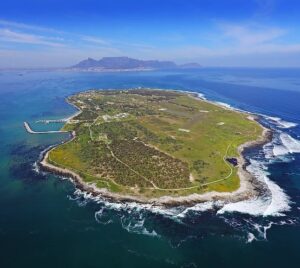 Robben Island
Robben Island is a small island located just off the coast of Cape Town, South Africa. For centuries it was used as a place of exile and imprisonment, and today it is best known as the site of Nelson Mandela’s incarceration.Today, Robben Island is a World Heritage Site and a popular tourist destination. Visitors can tour the prison where Nelson Mandela was held, as well as the island’s museum and lighthouse. The island also offers stunning views of Table Mountain and the surrounding ocean.
 Kirstenbosch Botanical Garden
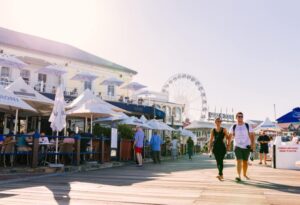 V&A Waterfront
The Victoria & Albert Waterfront in Cape Town is one of the most popular tourist destinations in South Africa. Situated on the Atlantic Ocean, it offers stunning views, a variety of shops and restaurants, and a busy calendar of events.
The Two Oceans Aquarium is a must-see for anyone visiting the waterfront, and the food markets are a great place to find fresh produce and local specialties. For those looking for a more traditional shopping experience, there are a number of shops selling African crafts and souvenirs.
The City of Cape Town is a diverse and fascinating city, made up of a number of different geographic areas, each with their own appeal. The skyscrapers and lively streetscape of the Central City are surrounded by various areas which offer a unique and beautiful mix of suburban and back-country, rich with natural scenery.
In addition, there are the popular tourist areas of Robben Island, the dramatic shores of the Cape Peninsula and the additional offerings beyond the city, which are popular for activities such as wine tasting in towns like Franshoek or Stellenbosch, or whale watching in Hermanus.
Atlantic Seaboard
Getting Around Cape Town
Discover Transport
There are a few different ways to get around Cape Town, depending on your budget and needs. If you’re travelling on a tight budget, the best option is to use the bus system. Bus tickets are relatively cheap, and you can use them to get around the city quite easily.
- CAB OR TAXI – Visitors to Cape Town can make use of metered taxi cabs or ride-sharing services like Uber which are easy to find near the airport or major attractions in and around the city. Both options offer convenient transportation around the city to get to and from popular tourist destinations.
- CAR HIRE – Use local car hire companies to rent a car and explore the city on your own schedule. There are many rental companies to choose from, offering a range of vehicle sizes and classes. It is a convenient and flexible option to easily visit different parts of the city and popular tourist destinations.
- BICYCLE – Cape Town is a bike-friendly city with a variety of options for visitors looking to explore the city by bicycle. Several rental companies offer daily, weekly, or monthly rentals, as well as guided tours. The city also has an extensive network of dedicated bike lanes and routes, making for safe easy travel.
- TRAIN – Experience the breathtaking beauty of Cape Town by railway on the Southern Line. The city’s convenient and affordable trains will take you on a journey through the city, with multiple stations located throughout to make it easy to explore all that Cape Town has to offer.
- BUS – Cape Town has a number of private bus companies and commuter bus services, as well as the City Sightseeing bus. The City Sightseeing bus is an awesome way to see the city at your own pace as you jump on and off at your leisure. The MyCiti bus is another quick way to get around the city.
HOW TO TRAVEL WISE IN CAPE TOWN
Download the guide to navigating safely in our beautiful city.
